
Probability
You will be expected to know the probability content from GCSE, namely:
- Addition of mutually exclusive events
- Multiplication of independent events
- Using tables, Venn diagrams and Tree diagrams
- Using conditional probability
In this video we talk through some of these probability concepts.
In addition to this, you might be asked questions which require you to count the number of arrangements, You could also be asked to calculate expectation. In this video we explain a little bit about what the "Expectation" is, and this concept appears in the first example interview below.
Interview question examples
Here are some questions for you to try. Each one has a link to a video where we discuss the question and some possible methods which can be used to solve it.
Question 1: How can you use a fair coin to make a fair choice between three different objects?
The follow up parts of the question are given in the hide and reveal section below.
Next parts of the question
(a) If the objects are A, B and C, using your method what is the probability that I pick option A? (You will need to justify the answer, not just state it!)
(b) On average, how many "goes" would you expect the have to take in order to make a choice.
In the video below one of our undergraduate mentors attempts the problem.
Question 2: A class has $n$ pupils, of whom $r$ play hockey (where $2 \le r \le n$). The $n$ pupils are arranged in a row at random. What is the probability that there is a hockey player at each end of the row?
Next parts of the question
(a) What is the probability that all of the hockey players are standing together?
(b) Find the probability that no two hockey players are standing together.
Question 3: I asked an AI to write a probability interview question for me. The image below shows the resultant attempt and their "solution".
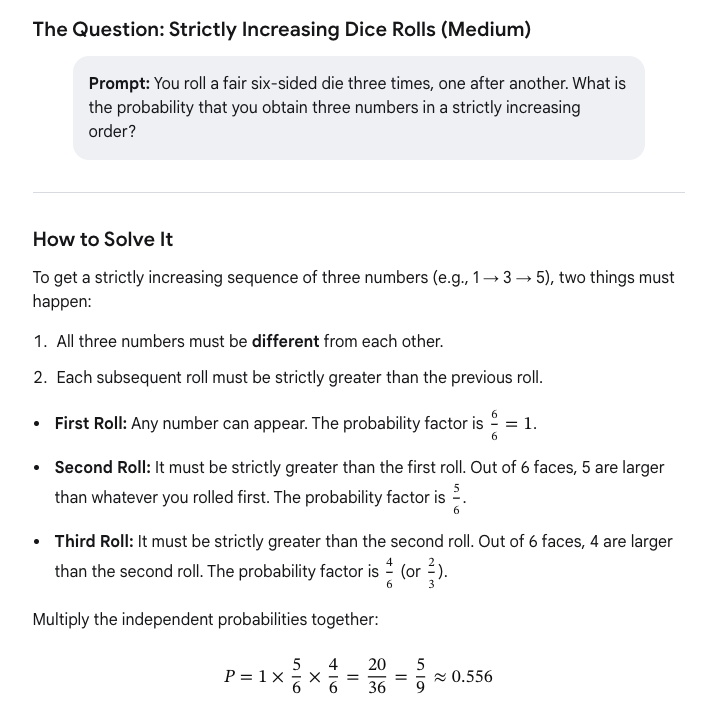
(a) Without calculating any probabilities, explain why the answer is obviously wrong!
(b) Find the correct probability.
More Practice Questions
Here are some STEP questions which might be useful. You can find the individual questions on the STEP database.
- 2001 STEP 3 Q13 (2015 STEP 2 Q12 is based on a similar idea)
- 2016 STEP 1 Q12
- 2013 STEP 2 Q13
- 1994 STEP 1 Q12
- 2010 STEP 2 Q13
- 2005 STEP 1 Q12
You can also try an internet search for "Probability Interview Question". Be a bit careful about trusting AI solutions as they can be very wrong!